
measured and found wanting
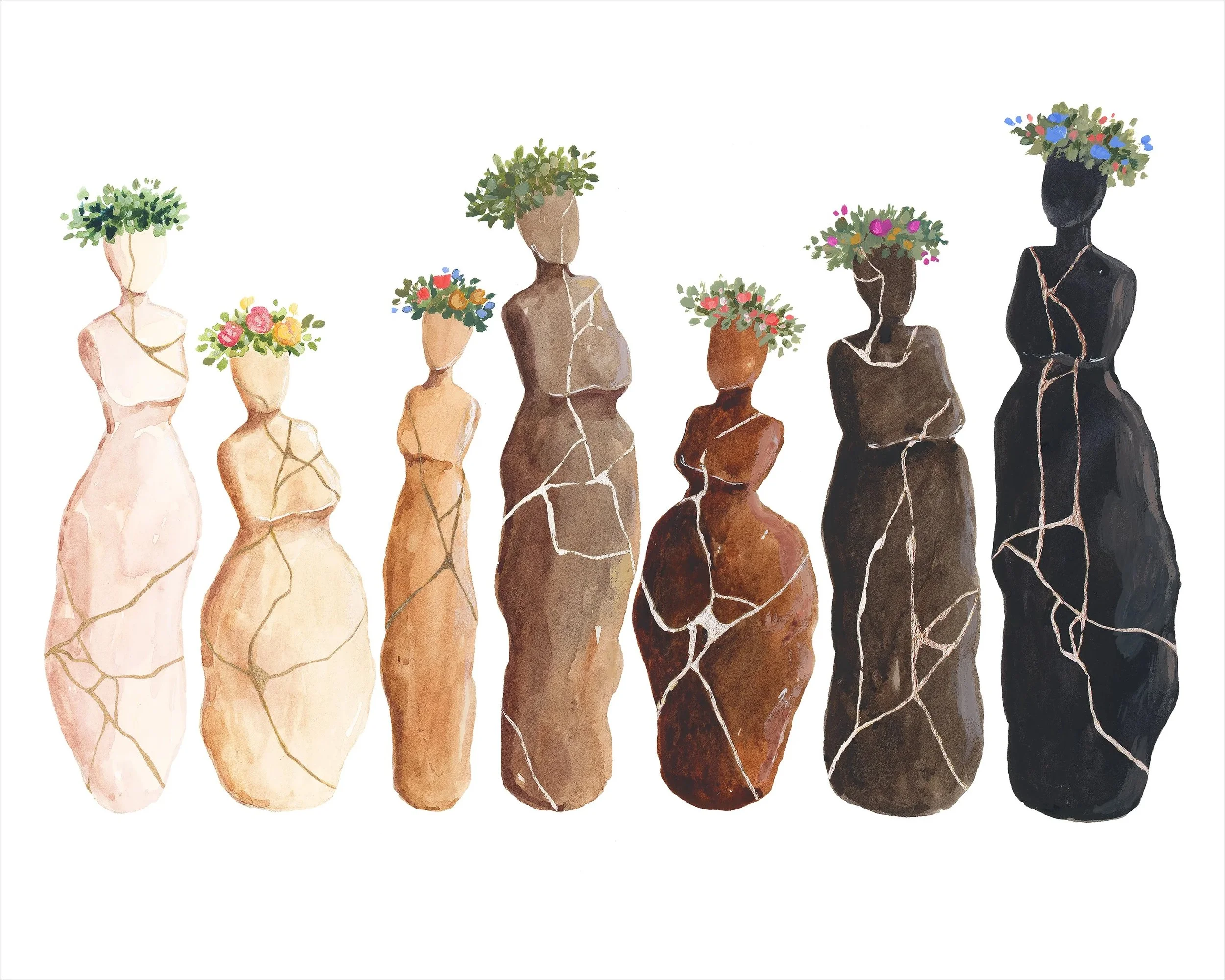
“Broken and Beautiful” by Paige Payne
I was sitting in a room filled with hundreds of women (something utterly overwhelming to my introverted nervous system). We were grouped at tables of eight. The room was abuzz with energy. These women, of all ages and stages, had gathered for the weekend, eager to connect with one another over their shared desire to communicate the love of Christ to the world.
Our host, a renowned and loved author, welcomed us and set the stage for our weekend together. As she launched into her opening session, she began recounting her tenuous journey with food and her body. Her words landed on me, weighted by a shared struggle, yet carrying a sense of relief in the reminder that I am not alone.
The air in the room was hushed and heavy, every woman leaning in as she spoke. And then she said, “Nothing tastes as good as skinny feels.” I don’t remember the context, whether there were caveats or sentences that couched the catchy phrase. I don’t even remember what I thought or felt about it at the time—whether I nodded agreeably or if I felt uneasy with the statement. But I have never forgotten those words she uttered more than ten years ago.
I’ve not consciously thought about that phrase since I first heard it. It may have passed through my mind fleetingly throughout the years. But last year, her words resurfaced and lingered. This time, however, they were in my own voice as a sort of shame-laced admonition. It seems the small seed planted years ago took root in fertile soil and slowly grew within my subconscious.
When I was a scrawny pre-teen, my nana wrapped her arms around me and said, “Man, ya gettin fat!” Her words were a mirror, shaping how I viewed myself in the world. I am now fifty-three years old. My body is changing with every passing year, more rapidly than it did in my twenties and thirties. Combine that with the fact that I have lived aboard a small sailboat for the last three years, which has drastically changed my eating habits and activity levels. All of these changes have increased the dis-ease I feel in my own skin.
Being at peace with my body has never come easily to me—the pendulum always swinging between feeling too much or not enough. Sometimes the dis-ease is over her form, how she looks, or doesn’t look. Other times, it is over how she does or does not perform.
How I feel about my body often influences how I treat her. I have treated her as something to be evaluated, improved, and presented for approval—a means to an end rather than a good gift to be lived in. I have not been kind to her in thought, word, or deed, by what I have done and what I have left undone.
As I reflect on the past fifty-plus years, I clearly see that I have been frustrated with every version of myself. The twenty-year-old version was full of self-hatred, but a decade later, the thirty-year-old longed for the twenty-year-old version. The forty-year-old for the thirty-year-old edition. And now that I am into my fifth decade, I wonder what was so wrong with the forty-year-old body that I disliked so much.
Each version of me looks back wistfully at her predecessor. Yet I have not been able to translate that retrospection into the kind of wisdom that enables me to appreciate the body I currently inhabit. Discontent simmers below the surface—rarely enough to erupt into full-blown self-hatred, but regularly enough to disrupt peace.
I know I am not alone. I wonder how many women at that conference table ten years ago wore that phrase home like a cloak of shame? How many of us whispered it to ourselves in front of dressing room mirrors while shopping for bathing suits or jeans? Or as we stepped on the scale or made yet another New Year’s resolution?
I’ve heard the familiar language of my struggle in countless conversations since. It is a sisterhood that connects us, but none of us wants to belong to. The woman who despises her postpartum body. The young woman who acutely feels her inadequacy while scrolling through Instagram and TikTok, where influencers peddle the latest and greatest diet trends and beauty hacks. The older woman who is desperately trying to stave off signs of aging. We are daughters, mothers, and grandmothers, each generation inheriting and passing down liturgies shaped not by Scripture but by the world’s ideals, our own flesh’s insecurities, and an enemy who delights in our shame.
And yet, as much as this feels like a uniquely female burden (and in many ways it is, given how our culture views and treats women’s bodies), I know it’s not ours alone. It is pervasive to us all, male and female; it just manifests in different ways. We all inhabit bodies marked by the fall—bodies that won’t cooperate, won’t conform, and won’t let us forget our mortality. Some of us rail against what our bodies can’t do; others against what they look like.
While our individual struggles with our bodies are varied, the underlying ache is the same: the flesh we live in is fleeting, fragile, and fractured. This goes all the way back to the fall in Genesis 3, when the good bodies God created experienced the first stings of death and shame. And ever since then, we have wrestled with the dissonance between God’s claim that our bodies are “good” and our experience which feels like anything but that.
While we may all have times we feel ambivalent toward our bodies, it is particularly challenging to be a woman in a society that somehow simultaneously elevates and denigrates, idolizes and demonizes the female body. And, to be honest, I am tired. Tired of the battle, tired of the shame, tired of living at odds with the body God gave me. Which brings me back to the question that’s been nagging me for over a decade: How did we get here? How did the body God called “good” become a battleground and a frequent source of shame?
I have sat with that question for a long time. Long enough to know that the answer is not simple, and that I am not alone in asking it. What I find myself longing for, what I suspect many of us are longing for, is what the Bible calls shalom. Not merely the absence of conflict with my own body, but the presence of everything necessary to flourish. To finally feel at rest in my own skin.
Many faith-based conversations about the body are sorely lacking. Sometimes, we overcorrect, rejecting anything to do with the body and treating it as less than spiritual. Youth leaders center women’s bodies in conversations around sexual purity and pastors center it around a husband’s fidelity. Other times, we spout trite Christian cliches as a verbal ascent to the goodness of the body. But in many ways, Christians are just co-opting cultural trends and “Christianizing” them. “Stewardship” can be just another word for diet and exercise. “Fearfully and wonderfully made” can be a sanitized version of “Real women have curves.” Or as one podcaster put it, “Instead of doing something to be thin, we are doing it to be healthy.” But the goal is the same. As she goes on to state, healthy is often synonymous with thinness.
It is not to say there is no truth or goodness to be found in these things. Self-care is important. But who defines that, and how is it measured? And does that determine a body’s value? While there can be nuggets of truth mined in culture and Christian subculture, the offerings they provide still fall short of the kind of truth that brings freedom, wholeness, and peace.
All of these attempts at defining what is “good” point to our inability to make peace with being embodied in a world still marked by the curse. Sin invaded, casting shadows over every aspect of God’s good creation. It is hard to make peace with our bodies, to inhabit them wholeheartedly, because the battle for that goodness wages on three fronts: culture, our experiences, and the enemy.
The Culture
I have a terrible habit of scrolling through social media—when I’m bored, when I’m avoiding something, when it’s been five minutes since the last scroll. And scrolling through social media can be the thief of shalom.
I can be mindlessly scrolling on a random Monday, relatively unaffected, when the profile of a Christian influencer stops me in my tracks. The photos are beautiful. The captions are warm and full of gospel language. But somehow, rather than being inspired, something inside me shifts.
What I feel in those moments is hard to name. Things like envy, discontentment, and self-deprecation come busting in through the front door like your aunt Tammy Sue on Christmas Day, and so they tend to get the most attention. But this other thing slips in quietly through the back door in the form of a verdict: Not Good Enough.
I didn’t arrive at the verdict on my own. It has been spoken over me repeatedly, by a world with very strong opinions about what a good body is.
Culture is loud, constantly abuzz. You can hear it in pop songs and family dinners, in the well-meaning advice of friends, and in the carefully curated feeds of Instagram influencers (Christian ones included). We are inundated with opinions, trends, and contradictory scientific studies. “Good” is a moving target, defined subjectively by those with the power and influence to shape culture. Is it strong or feminine? Fair or dark? Tall or petite? Bold or meek? Curvy or thin? The end result is a very narrow subset of women; every other woman finds herself relegated to the margins.
These voices play a significant role in shaping what the rest of us consider good. But I want to be careful here, because the world is full of things that are good, beautiful, and true. God is not absent in culture. Art draws us in, helping us appreciate beauty and notice things we might otherwise miss. Books disarm us and invite us to deeper reflection. Music often gives voice to how we feel and to what is beautiful or broken. These are all valuable.
But the same culture that offers us glimpses of the true and beautiful also quietly and persistently hands us a much narrower story about what our bodies should be. And that story does not loosen its grip simply because we are followers of Christ. If anything, it creates holy, one-size-fits-all standards when, in actuality, every body is different, responds differently, and needs different things. It finds new Christian-sanctioned vocabulary and then walks right through the church doors with us.
Within Christian subculture, women who grew up in purity culture have been taught their bodies are objects of lust that tempt men to sin. These kind of messages steep women in shame. How is she to find freedom from shame when the very source of it is the body God gave her? Even within the church, women’s bodies are objects—held up, measured, scrutinized, and sexualized.
Our Experiences
Over the last few months, my eleven-year old niece has been learning the disappointment that comes when your own body turns against you. Because of an autoimmune issue, the body that once enabled her to enjoy playing soccer now experiences acute pain and fatigue.
Inhabiting bodies in a broken world is complicated. Because we experience life in and through our bodies, how we feel about them grows out of our stories, our experiences. Some of us grew up with moms steeped in diet or exercise culture; others grew up with moms whose love language was plates full of food.
If you were teased or bullied for how you look, your body is a source of great humiliation and pain. When we suffer from mental illness or chronic pain, or if the body we inhabit endured trauma, our bodies feel more like enemies than good God-given gifts. And sometimes, as in the case with my niece, the very thing the body was designed to do—attack disease and heal itself—or in the case of trauma survivors—react and respond to danger—is the very thing that keeps us trapped.
Whether we are experiencing the weakness of our bodies—bodies that don’t function the way they are supposed to—or the woundedness of our bodies—bodies that have suffered grievous injustices, unkindness, and evil—living in a broken body in a broken world is hard. And when it feels like your own body is a source of pain and betrayal, what recourse do you have? How do you reconcile “fearfully and wonderfully made” with defective or defiled?
The brokenness of the world and the sins others commit against us play a huge role in shaping our thoughts and feelings toward our bodies. But struggles with our own sin also play a significant role. We reject our limitations. We despise the way God uniquely crafted us, desiring to be something else instead. We strive to perfect the outsides, beating our bodies into submission. We crave and chase all the things we think will satisfy and fill the void. Or we despise them so much we ignore them altogether.
We need to be honest with God and ourselves about our own sin. This is vital to our growth in Christian maturity. But oftentimes, the Christian conversation about our bodies centers solely on our own sin, without addressing the soil in which that sin developed. Why do we want the approval of others so desperately? What wound are we trying to heal, what need are we trying to address? Where did the void we are attempting to fill originate? Attempting to treat these mortal wounds with superficial treatments and cliches will not move us toward wholeness.
The Enemy
There is one final voice. And it is, perhaps, the most sinister and subversive. That is the voice of the enemy. What makes his voice so hard to detect is that it sounds so much like my own voice.
The enemy despises all that God created and declared good. He condemns what God has blessed. His whispers mock and shame us when we look in the mirror or when a piece of clothing that used to fit is now tight. He draws attention to our “flaws” and tempts us to do whatever it takes to hide them from the gaze of others. He promises joy and freedom can be found in the next trend or a smaller dress size.
He is the father of lies. He takes the body God fashioned with intention and whispers that it is a problem to be solved rather than a gift to be stewarded. And where Jesus came to bring hope, healing, and freedom to his people, the enemy comes to steal, kill, and destroy (John 10:10). He is intent on our destruction—whether it be our peace, our hope, our joy, our freedom, or our bodies themselves.
He doesn’t care if his efforts result in our attempts at self-perfection or self-destruction, so long as he can tempt us to believe that what God has provided is not good enough. And he has been doing that same thing since the garden (Genesis 3:1-5).
God’s Voice
Against all of this—the world’s verdicts, our own vulnerabilities, and the enemy’s mocking—God, the one who bought us through the breaking of his own body, has something to say about our body.
Maybe a better starting point is this: When God fashioned a body for me, for you, what was on his mind? What did he envision? Our bodies were always meant to cultivate and enjoy the world he entrusted to us. They weren’t objects to be perfected but a means of communion with God and others.
Our bodies are good because God made them good. He made them to be his dwelling place and vessels through which love may flow. They are the gift he gave us to encounter and engage the world around us.
Our bodies worship.
Our bodies rest.
Our bodies pray.
Our bodies delight.
Our bodies grieve.
Our bodies rejoice.
Our bodies weep.
Our bodies laugh.
Our bodies endure.
Our bodies give and receive love.
And we can do that in bodies weathered from the years or full of youthful zeal. We can do it from weak, frail bodies or from bodies in their prime. We can do it whether or not we meet the world’s standards of “good” or our own. We can do it from differently abled bodies and neurotypical bodies. Even when we lose our capacity to do any or all of that, the fact that we exist and that God created our bodies means that they are good.
They are not perfect. They are still affected by the curse of sin. They don’t always operate as they were intended. Acknowledging their goodness does not erase the reality of their complexities. But each time I experience life in this body, whether weeping or rejoicing, loving or being loved, twenty pounds overweight or “fit and fabulous”, in fragility or strength, I can remember that God gave me this body. I can honor it for all it has endured. And I can thank God for the good body he gave me, even while I wait for the healed and whole resurrection body to come.
I still think back to that women’s retreat many years ago. All those women at their tables, hungry for something true. I wonder what we might have carried home instead? What if instead of holding out the empty promise of “skinny” she offered us the substantive hope of solidarity, solace, and shalom?
What if she said,
“Sisters, I know life in this body is hard. I know you are constantly measured and found wanting. I know your body feels like a battlefield at times. I know it has been abused, neglected, bullied, mistreated, ogled, mocked, and rejected. I know that it doesn’t always work the way God intended.
But the God who created you and called you good has taken up residence in you.
He is with you in your neurodivergent body.
He is with you in your body that is twenty pounds overweight. He is with you in your aged, arthritic body. He is with you in your menopausal body.
He is with you in the body that cannot bear children. He is with you in the body wracked with pain.
He is with you until you draw your last breath and your body returns to dust.
Even when our bodies give out and are laid in the grave, his promises and presence do not end.”
As I look toward Easter and celebrating Christ’s resurrection, I am struck again by the truth that the one, true and living God took on our flesh. He offers us the ultimate solidarity.
He, too, experienced a body under the curse, which means that he suffered in every way we do.
His body knew sickness.
His body knew hunger.
His body knew pain.
His body knew weariness.
His body knew abuse.
His body knew brutality.
His body knew evil.
His body knew sleepless nights.
His body knew headaches and stomach aches and back pain and weakness and fragility and suffering.
He even knew death.
And after he rose from the dead, his glorified body still bore the scars of his suffering—a visible reminder of what his body endured.
Easter reminds us that none of those things has the final say over our bodies. Not even death. Jesus’ resurrected body speaks a truer word than anything we endure. Suffering in this body—whether emotional, mental, spiritual, or physiological—has a definitive end date.
And his resurrection is the first fruits of our promised resurrection to come.
He has promised that though our earthly bodies will be buried when we die, they will be raised to live forever. Though they are buried in brokenness, they will be raised in glory. Though they are buried in weakness, they will be raised in strength. Though they are buried as natural human bodies—subject to all manner of suffering—they will be raised as spiritual bodies no longer afflicted by the curse (1 Corinthians 15:35-57). He will take our weak mortal bodies and change them into glorious bodies like his own (Philippians 3:21).
I think that is the truth I needed to hear that day. One that didn’t sanitize or standardize, but one that grounded me in the reality of life in this body while holding onto hope for the body to come.
May we all find solid hope in this truth.
Additional Resource:
I wrote a book called Body Matters about this topic in 2015. Though there are many things I would say differently or aspects of this topic I would like to explore more deeply, it does explore the complexities of this topic in more depth than an article can. You can find the book here.
Also, you can find Paige Payne’s print, “Broken and Beautiful,” and more of her incredible work here.

Questions for Reflection
Engage the Scripture
Where do you feel tension between what Scripture says about your body being “good” and your lived experience in your body? How do you typically respond to that tension?
As you reflect on passages like Genesis 1–3 or 1 Corinthians 15, what do they reveal about both the dignity and the brokenness of your body—and how does that shape your hope?
Explore Your Story
What messages about your body have you internalized over the years, and where did they originate (family, culture, church, personal experiences)?
When you look back at previous versions of yourself, what do you notice about how you viewed your body then—and what might that reveal about how you see your body now?
Encounter the Savior
How does it change your perspective to consider that Jesus experienced life in a human body marked by suffering, limitation, and pain?
In what ways might Jesus be inviting you to see and relate to your body differently—with more compassion, dignity, and truth?
Experience Shalom
Take a few quiet minutes to sit still, noticing your breath and your body without judgment. What do you sense, and can you offer gratitude to God for one aspect of your body as it is today?
Practice saying a breath prayer during times of struggle. Place a hand over your heart (or another part of your body that feels burdensome) and pray:
Inhale: “This body is a gift.”
Exhale: “God is with me here.”
What shifts, if anything, as you rest in that truth?
The Wholehearted Project is reader-supported.
If you enjoy or have benefited from the content, would you consider supporting future content by becoming a financial supporter through a one-time gift at Buy Me A Coffee or becoming a recurring supporter at Liberapay.